• Skip to main content
  • Skip to secondary menu
  • Skip to footer

Opinion.org

#Opinion: opinion matters

  • Sponsored Post
  • About
  • Contact

Social costs of U.S. air pollution are down across economy, but vary widely between sectors

September 10, 2019 By Opinion.org Leave a Comment

Air pollution negatively impacts the U.S. economy, costing the U.S. roughly 5% of its yearly gross domestic product (GDP) in damages ($790 billion in 2014). The highest costs come from early deaths, attributable to exposure to fine particulate matter (PM2.5).

However, damages from air pollution in the U.S. are sharply falling, as levels of outdoor air pollutants have decreased in recent years, according to recent research from the Center for Air Quality, Climate, and Energy Solutions (CACES) at Carnegie Mellon University (CMU). The study, published in this week’s issue of the Proceedings of the National Academy of Sciences, shows that external damages from air pollution have fallen 20% recently over just a 6-year span (2008 to 2014).
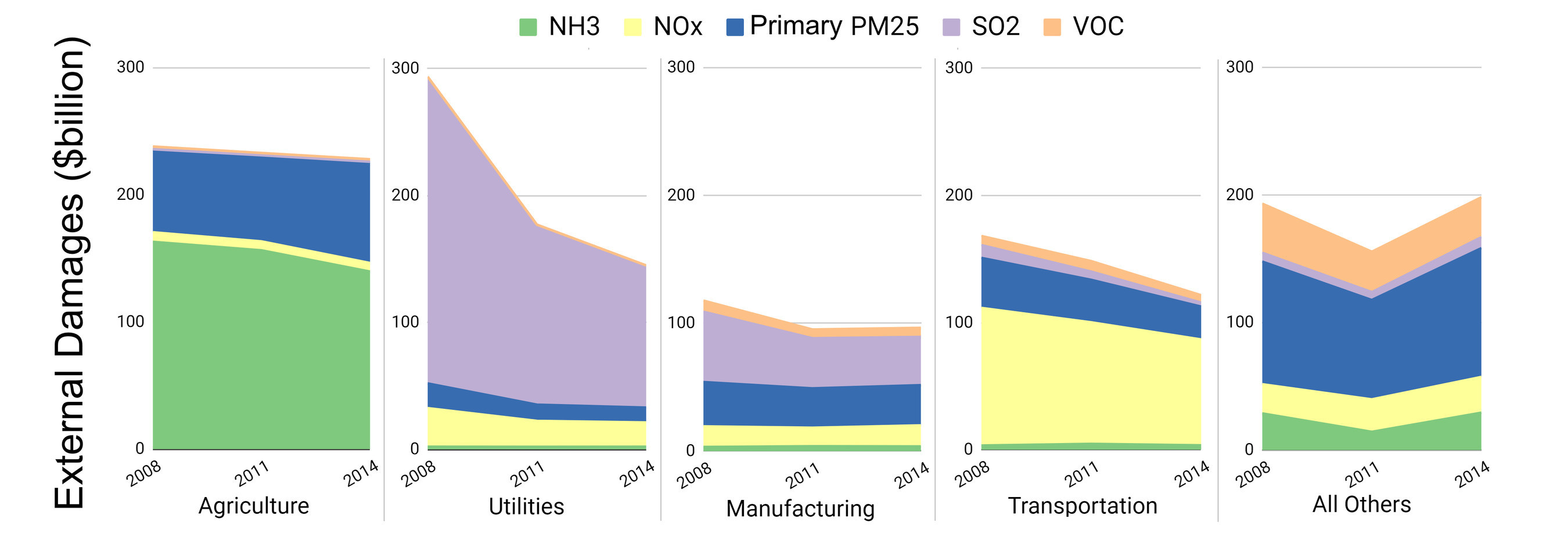
External damages from fine particulate matter air pollution by economic sector and precursor pollutant for 2008, 2011, and 2014 (in billions of dollars, 2018-adjusted).

“It is a really a sharp decline,” says Nick Muller, joint professor Engineering & Public Policy (EPP) and Economics (Tepper School of Business) at CMU.

While some PM2.5 in the atmosphere is the result of natural processes, such as forest fires or windblown dust, the majority of the damages from PM2.5 are related to human activities, most of which can be attributed to different sectors of the economy (e.g. manufacturing, agriculture, etc.). Combining damages with more traditional measures of economic production, such as GDP or value-added, provides a more accurate picture of a sector’s full economic impact.

“We know the economy changed a lot between 2008 and 2014,” said Muller, pointing to a wide range of economic trends such as the rise of cleaner energy sources like natural gas and renewables amidst the decline of higher-polluting coal, the retirement of some heavier manufacturing industries, and even the Great Recession where economic production (and thus emissions) slowed. “They all show up in the air pollution damages.”

Damages attributable to the utilities sector fell dramatically from 2008 to 2014, by more than 50%. More modest were decreases in other large economic sectors, such as manufacturing (20%), transportation (30%), and agriculture (4%). Agriculture ($230 billion in air pollution damages in 2014) has now replaced utilities ($150 billion in 2014) as the economic sector with the highest level of damages, according to the study.

Air pollution damages are largely concentrated within a small number of economic sectors: the top four sectors responsible for the highest external damages (agriculture, utilities, manufacturing, and transportation) contribute just under 20% of GDP, but are responsible for over 75% of all air pollution-related damages.

PM2.5 can be emitted directly into the atmosphere (as “primary” PM2.5) or formed through atmospheric chemical reactions that slowly turn emitted gases into PM2.5 (“secondary”). Disparate economic activities, from agriculture to power generation to water transportation, each contribute their own unique mix of chemicals to the atmosphere, but each ultimately contributes to PM2.5. The study tracks the magnitude of damages arising from each major category of emissions within each part of economy.

Utilities-related damages, for example, are largely driven by sulfur dioxide (SO2), a by-product of coal combustion, which forms secondary PM2.5 downwind of the smokestacks it comes from. Decreases in SO2 have driven down damages from utilities in recent years. Ammonia, the largest contributor of damages from agriculture, is emitted through both livestock-raising and fertilizer application, forming secondary PM2.5 downwind of farms.

“The chemical composition of damages is very different across the different sectors, and so you can’t treat the sectors the same,” said corresponding author Peter Tschofen, Ph.D. student in EPP. He and former CMU professor Ines Azevedo, now an associate professor at Stanford University, are Muller’s co-authors on the study.

Understanding the magnitude of damages from ammonia emissions compared to those from sulfur-dioxide, for example, and which economic sectors those damages correspond to, should help policymakers know where to focus their resources to further lower PM2.5 damages.

Like agriculture and utilities, each sector has its story of damages from its emissions. “This study shows where we need to do technological research to develop options for emissions controls,” said Muller. In the case of agriculture, unlike sulfur dioxide scrubbers at coal plants, technologies are not readily available to help reduce the ammonia being emitted across a tract of land.

“The damage calculations we’ve made are a key ingredient to inform future policy analyses” with both R&D and regulation in mind. “What I would urge a policy-maker to do when prioritizing future regulations,” said Muller, “is to look at the marginal cost of reducing emissions, both by sector and by pollutant” compared to the damages of not doing so.

Such recommendations will be further refined in the team’s follow-up work, which will focus on how damages from each sector are distributed across the country, as not all emissions are equal. Pollutants emitted in close proximity to urban areas do far more harm than those emitted where few people are around to breathe the dirty air.

About the College of Engineering: The College of Engineering at Carnegie Mellon University is a top-ranked engineering college that is known for our intentional focus on cross-disciplinary collaboration in research. The College is well-known for working on problems of both scientific and practical importance. Our “maker” culture is ingrained in all that we do, leading to novel approaches and transformative results. Our acclaimed faculty have a focus on innovation management and engineering to yield transformative results that will drive the intellectual and economic vitality of our community, nation and world.

About Carnegie Mellon University: Carnegie Mellon (www.cmu.edu) is a private, internationally ranked university with programs in areas ranging from science, technology and business to public policy, the humanities and the arts. More than 13,000 students in the university’s seven schools and colleges benefit from a small faculty-to-student ratio and an education characterized by its focus on creating and implementing solutions for real world problems, interdisciplinary collaboration and innovation.

SOURCE Carnegie Mellon University’s College of Engineering
https://www.cmu.edu

Filed Under: Opinion Tagged With: Air pollution, emissions controls

Reader Interactions

Leave a Reply Cancel reply

Your email address will not be published. Required fields are marked *

Footer

Recent Posts

  • The Deal That Won’t Hold — And Why That May Be Correct
  • Washington’s Iran Capitulation Will Cost More Than the Deal Is Worth
  • Trump’s Indecisiveness Has Emboldened Iran. Now Trump Is Cornered.
  • The UAE’s OPEC Exit Is a Middle East Realignment, Not an Oil Story
  • Hormuz Is a Message to Beijing and Moscow
  • Ammunition Drain: How the Iran Campaign May Be Weakening Taiwan’s Deterrence
  • Woe to the Vanquished: Iran Still Does Not Get It
  • U.S. Treasury Sanctions 20 Companies and 19 Vessels in Iran-Related Action, Targeting Chinese Refinery
  • Iran Will Sign Anything — And That’s Exactly the Problem
  • The Meme War America Didn’t See Coming

Media Partners

  • Media Presser
  • k4i.com
  • Policymaker.net
MarketAnalysis.com Publishes Comprehensive Quantum Computing Equity Memo Covering IONQ, QBTS, RGTI, QUBT, XNDU, INFQ
What Is an Analyst Call
China Has Shed $357 Billion in U.S. Treasuries Since 2021
Foreign Debt Holdings Are a Trade Deficit Problem, Not Just a Fiscal One
Foreign Holdings of U.S. Federal Debt Reached $9.2 Trillion in 2025
Japan Holds $1.185 Trillion in U.S. Debt and the Number Tells an Incomplete Story
NAB 2026: Las Vegas and the End of the Broadcast Era
Private Investors Now Dominate Foreign Holdings of U.S. Treasury Debt
The United States Paid $282 Billion in Interest to Foreign Debt Holders in 2025
Why Belgium Holds More U.S. Debt Than Saudi Arabia, and What That Actually Means
Berkshire's $10 Billion Alphabet Buy Is a Signal, Not a Trade: The AI Build-Out Is Just Getting Started
Qualcomm and the AI Infrastructure Boom: A 62% Rally Ahead of the Revenue
Adobe's Structural Problem Is Not Competition. It Is Displacement.
Cloudflare's Path to a Trillion: The Edge Inference Bet
Marvell Q1 FY2027: The $15 Billion Number Behind the Beat
Cuba, The Last Caribbean Dictatorship
Quantum Stocks Are in the Wrong Place as Inflation Keeps Grinding Higher
What the Market Inferred from Micron's Numbers, and Why It Got There Wrong
How Japan Lost Semiconductor Leadership to Taiwan
Nikkei 225 Has Gained Nearly 7% in Four Sessions. Here Is Why.
Film Star Vijay Forms Government in Tamil Nadu: The Celebrity-to-Power Trajectory Completes
The Gulf Realignment Washington Missed
Seven Million and Counting: Britain's Managed Demographic Replacement
UK Taxpayers Are Funding £4 Billion a Year in Student Loans for Foreign Nationals
The Strait of Hormuz and the Limits of Chokepoint Leverage
Sheikh Khaled Goes to Beijing: A Resilience Play Against Iranian Revival
After the Franchises: The Technocratic Turn
The Franchise Model of Neo-Autocracy
The Left Franchise and Its Losing Causes
The Merz Standard: Europe's Preferable Leader Type

Media Partners

  • Press Club US
  • 3V.org
  • ZGM.org
Judge Dismisses Ray Epps Defamation Case Against Fox News a Second Time
The DOJ's Comey Campaign Is Costing It Prosecutors
Iran Sits on UN Boards for Women's Rights, Nonproliferation, and Counterterrorism
Congress Moves to Protect Whales in San Francisco Bay with Save Willy Act
Palantir, DHS, and the Growing Fight Over Immigration Surveillance
Migration and the Limits of European Identity
Industrial Darwinism on the Battlefield: Ukraine’s Drone War Is Forcing a Rethink
Oil Flows Disrupted: Ukraine Strikes Hit Russia’s Baltic Export Arteries
Rubio: If NATO Bars Us From Using Our Own Bases, It's a One-Way Street
The Security Subsidy: Why European Rearmament Remains Stalled
Barilla Opens Good Food Makers 2026 Applications Through July 10
The Future Is Here, Just Not Equally Distributed
Westin Grand Central, Three Days in May: The 21st Needham Technology, Media & Consumer Conference
Berkshire Hathaway's Annual Meeting Without Warren Buffett
Canelo vs. Benavidez: The Fight Boxing Spent Years Avoiding
Elon Musk's Nvidia Comments and the Market Attention Problem
Generation Z in the Labor Market: What the Data Actually Shows
Harley-Davidson's 2024–2026 Recall and What It Signals
Joel Embiid and the Injury Question That Never Goes Away
Kentucky Derby 2026: What the Result Tells You
Technology, Finance, and Smart City Events: Selected Global Calendar, 2026
Two Signals, One Crisis
House Democrats Urge Mike Johnson to Restore Bipartisan Smithsonian Women’s History Museum Bill
Borders, Memory, and the Future of European Identity
Canon R100 Field Notes: Budget Gear, Real Results
Video Rebirth Secures $80 Million to Industrialize AI Video and Build the Next Layer of Digital Reality
A Brief History of Tea: From Ancient Leaves to a Global Ritual
Photography Workshop by Pho.tography.org — Spring Session
S3H.com Announces Groundbreaking Web Dev Service Launch
With Possible Strike Looming, Day Care Workers Deliver Solidarity Petition but Management Nowhere to Be Found

Copyright © 2026 Opinion.org

Media Partners: Market Analysis · Market Research · Referently · Photography · Hormuz · Taiwan Strait · Policy Maker · Publishing House

We use cookies on our website to give you the most relevant experience by remembering your preferences and repeat visits. By clicking “Accept”, you consent to the use of ALL the cookies.
Do not sell my personal information.
Cookie SettingsAccept
Manage consent

Privacy Overview

This website uses cookies to improve your experience while you navigate through the website. Out of these, the cookies that are categorized as necessary are stored on your browser as they are essential for the working of basic functionalities of the website. We also use third-party cookies that help us analyze and understand how you use this website. These cookies will be stored in your browser only with your consent. You also have the option to opt-out of these cookies. But opting out of some of these cookies may affect your browsing experience.
Necessary
Always Enabled
Necessary cookies are absolutely essential for the website to function properly. These cookies ensure basic functionalities and security features of the website, anonymously.
CookieDurationDescription
cookielawinfo-checkbox-analytics11 monthsThis cookie is set by GDPR Cookie Consent plugin. The cookie is used to store the user consent for the cookies in the category "Analytics".
cookielawinfo-checkbox-functional11 monthsThe cookie is set by GDPR cookie consent to record the user consent for the cookies in the category "Functional".
cookielawinfo-checkbox-necessary11 monthsThis cookie is set by GDPR Cookie Consent plugin. The cookies is used to store the user consent for the cookies in the category "Necessary".
cookielawinfo-checkbox-others11 monthsThis cookie is set by GDPR Cookie Consent plugin. The cookie is used to store the user consent for the cookies in the category "Other.
cookielawinfo-checkbox-performance11 monthsThis cookie is set by GDPR Cookie Consent plugin. The cookie is used to store the user consent for the cookies in the category "Performance".
viewed_cookie_policy11 monthsThe cookie is set by the GDPR Cookie Consent plugin and is used to store whether or not user has consented to the use of cookies. It does not store any personal data.
Functional
Functional cookies help to perform certain functionalities like sharing the content of the website on social media platforms, collect feedbacks, and other third-party features.
Performance
Performance cookies are used to understand and analyze the key performance indexes of the website which helps in delivering a better user experience for the visitors.
Analytics
Analytical cookies are used to understand how visitors interact with the website. These cookies help provide information on metrics the number of visitors, bounce rate, traffic source, etc.
Advertisement
Advertisement cookies are used to provide visitors with relevant ads and marketing campaigns. These cookies track visitors across websites and collect information to provide customized ads.
Others
Other uncategorized cookies are those that are being analyzed and have not been classified into a category as yet.
SAVE & ACCEPT