I don’t like conspiracy arguments and I don’t make them. When someone tells me a crowd is fake, or that a movement has a single hand behind it, my instinct is that they’ve mistaken agreement for coordination. Most protests are what they look like: people who believe a thing, showing up. I’ve said that about crowds I hated and I meant it.
So it took me a while to accept what the French government put in writing, and what two French reporters proved with bank records years before that.
Qatar and Turkey spent two decades buying the institutional ground under European Islam. Not as charity. Not as diaspora sentiment. As foreign policy.
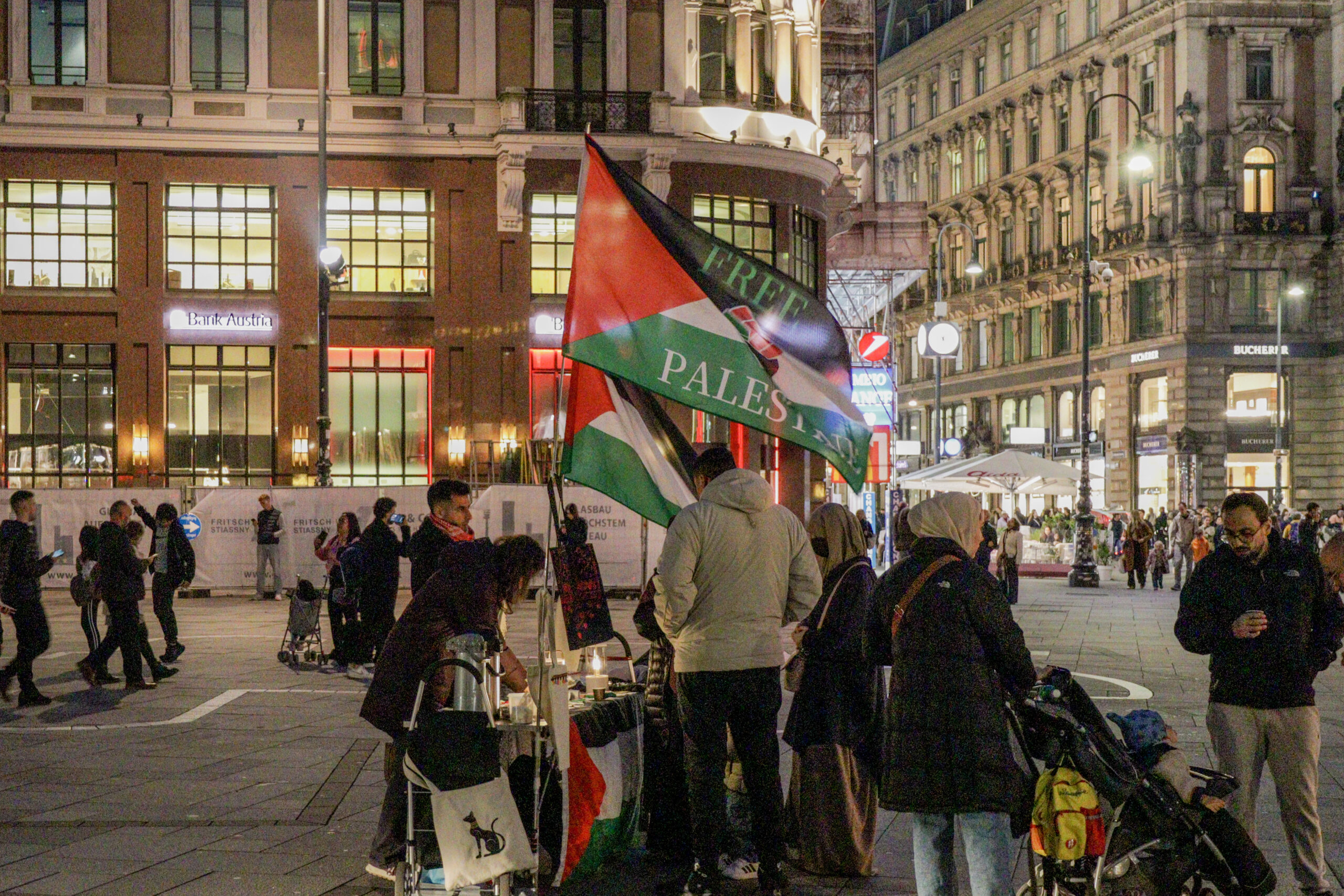
The people on the Graben in Vienna with a folding table and a candle aren’t on a payroll. That was never the claim worth making. The claim worth making is that somebody built the room they learned to think in, and we know who wrote the cheque.
Ask Who Paid for the Building
Christian Chesnot and Georges Malbrunot didn’t work from rumour. They worked from transfers, cheques and letters — roughly ninety million euros moved into Europe, with the overwhelming majority landing in organisations tied to the Muslim Brotherhood, routed through Qatar Charity and the emir’s own office. Malbrunot’s line about it was that this isn’t fantasy, and that the paperwork can’t be argued with. He’s a French journalist at Le Figaro, not an Israeli spokesman. That matters, because the reflex when an Israeli says this is to file it under propaganda.
Then Macron’s own Interior Ministry said it. The May 2025 report described a long-term strategy of entryism into schools, local government and public institutions, and named Qatar and Turkey as the financial backers of the European networks running it. A parliamentary commission followed and went further, describing separatist ecosystems in Lyon, Marseille and across the north where mosques, schools, charities and sports clubs function under a parallel authority. The report was so unwelcome that it sat unpublished until Le Figaro obtained it.
Turkey doesn’t even use intermediaries. The Diyanet selects the imams in French and German mosques, pays their salaries, and writes the Friday sermon in Ankara. There is no polite way to describe a foreign ministry of religion drafting the weekly political address delivered inside hundreds of European buildings. It’s a state broadcast with a congregation.
And the youth wing was bought outright. FEMYSO — the federation that trains the next generation of European Muslim organisational leadership, the one that gets invited to European Commission consultations — has taken over a million euros a year from Qatar since 2016. That is a cadre pipeline, funded by a Gulf monarchy, feeding into Brussels.
The Wire Transfer Is the Wrong Thing to Look For
The standard objection is that nobody has produced a receipt connecting Doha to a specific demonstration in Vienna or Berlin. True. Also beside the point, and I think people know it’s beside the point when they say it.
Influence operations that need a wire transfer per event are bad influence operations. The good ones pay once, at the start, for the thing that generates events on its own afterwards. You fund the institute that certifies the imams. You fund the schools that teach eleven-year-olds that divine law outranks the parliament they’ll one day vote for. You fund the student federation that produces the twenty-six-year-old who knows how to file a demonstration permit, brief a journalist and phrase a demand. Twenty years later a war starts and the machine turns over without anyone in Doha lifting a phone.
We accept this logic everywhere else. Nobody demands proof that Beijing wired money to a specific op-ed before conceding that Confucius Institutes shaped what gets said about Xinjiang on a campus. Nobody asks for a receipt tying the Kremlin to a particular German pipeline column. We understand that patient institutional money buys a disposition, and that a disposition is worth more than a rented crowd, because a rented crowd stops when the rent does.
This one doesn’t stop.
The Demands Aren’t Actually About Gaza
Here’s the test that convinced me. If this were solidarity with a people under bombardment, the demands would be about bombardment — ceasefire, aid, arms embargo. Some of them are. But watch what travels alongside, and what stays behind after each ceasefire.
The permanent demands are domestic. Blasphemy norms enforced by intimidation. Municipal accommodation that shades from reasonable into parallel. The reframing of secularism itself as a form of bigotry, so that a French teacher enforcing a French law becomes the aggressor. The French reports gave this a name — dissimulation, double discourse, victimisation — and the third element is the operational one. Any scrutiny of the funding becomes evidence of racism, which is a remarkably efficient way to make the funding unexaminable.
That’s the framework. Not a demographic fantasy about replacement, which I don’t believe and which does real damage to a serious argument. Something narrower and better documented: two states with an explicit political-Islamist doctrine spent a generation purchasing the institutional voice of a European minority, and are now cashing it against European domestic order, using a foreign war as the occasion.
What I’ll Concede
Half a million people marched in Madrid. Three hundred thousand in Barcelona. They were overwhelmingly Spanish, overwhelmingly not Muslim, and they were mobilised by BDS chapters, student groups, feminist collectives and grassroots unions — European left networks with their own history, their own money and their own reasons, none of which run through Doha. Anyone who tells you those crowds are Qatari assets is lying to you, and I won’t join them.
I’ll concede more. Most of the people at that table in Vienna have never heard of the Diwan Al Amiri and would be appalled to learn what funds the federation that trained the person who organised their evening. Sincerity is not in question. Sincerity is the product.
What I won’t concede is that scale disproves the argument. The whole point of buying institutions rather than crowds is that the institutions recruit people who have no idea they were recruited. A movement is not less engineered because most of its participants are genuine. It’s more engineered. That’s what success looks like.
Follow the money to the building, not to the march.